
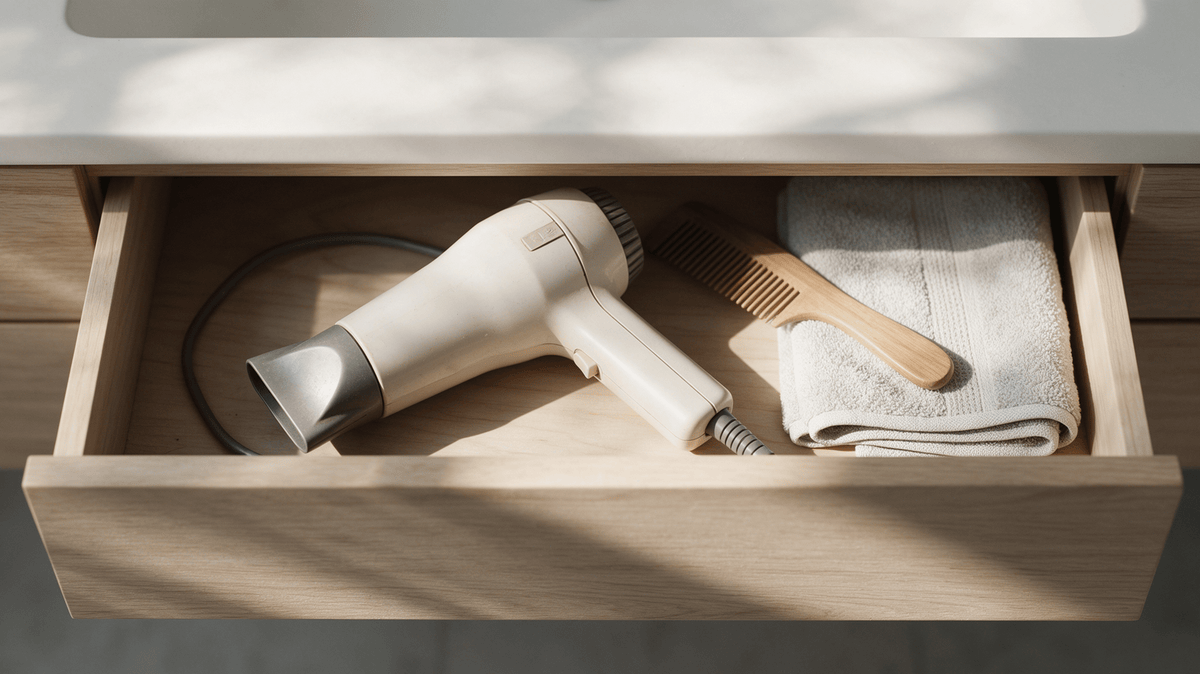
Hair Dryer for Women Over 50: Why Weight Matters More Than Wattage
Most hair dryers are chosen in a shop, held for ten seconds, and judged on how much air they push. Then they come home, and the real test begins: five, ten, fifteen minutes with the dryer held up above your head.
After 50, that test usually changes in two ways at once. Hair is often finer and thinner than it used to be, so it needs less heat rather than more. And the arm doing the holding is more likely to notice the weight of whatever is in it. Both changes point the same way — toward a dryer that is lighter, gentler and easier to control, not one with a bigger number on the box.
Why the number on the box is the wrong thing to shop by
Walk down any aisle and every box is selling wattage. It is the easiest figure to print and the easiest to compare, but it measures one thing: how much electricity the dryer draws. It says nothing about how heavy the dryer feels after ten minutes, how steady its temperature is, or how easy it is to aim.
For hair that has become finer, that gap matters. A higher wattage is not the same as better drying, and more power is not a better result. In everyday use the problem looks like this: a heavy, high-output dryer that is awkward to hold ends up held closer to the head, in one spot, for longer — which is the opposite of careful drying.
So the useful question is not how powerful the dryer is. It is whether you can hold it comfortably and control it precisely for as long as the job takes.
What to look for instead
- Weight, tested at arm's length. A dryer that feels fine in a shop feels very different after five minutes above your head. Around 250 g — roughly the weight of a phone — is a different experience from a full-size dryer.
- A balance point in your hand. Where the weight sits matters as much as how much there is. A dryer weighted toward the grip takes far less effort than one that pulls forward at the head end.
- Stepless airflow, not two fixed speeds. High and low buttons force you to choose between too much air and not enough. A slider you can move continuously lets you dry the roots with direction instead of blowing the style out of your hair.
- A genuinely gentle heat setting. Look for a lower temperature you can leave on, not just a slow fan with the element still hot. A room-temperature setting is worth having too, for finishing.
- Steady temperature. A dryer that checks its own outlet temperature continuously holds its setting instead of drifting warmer as the hair dries.
- A compact body and a sensible cord. Easier to hold at an angle, easier to store, and easier to pack.
Holding it comfortably
Arm fatigue is not a small detail. When a dryer is heavy or badly balanced, the natural response is to hold it closer to your head and to stop moving it, because that takes less effort in the moment. Those two habits — close and still — are exactly the ones that concentrate heat in one place.
The fix is practical rather than medical: a lighter dryer, balanced over the hand, makes it easier to keep the dryer at a comfortable distance and keep it moving. If holding a handle for several minutes is tiring, that is a question of effort — and effort is something a well-designed dryer can reduce.
Technique matters too
- Dry the back and sides first and leave the front for last, while your arm is still fresh.
- Sit if you can. Drying at eye level instead of with your arms raised removes most of the strain.
- Towel-dry first, so the dryer has less water to remove.
- Start on the lowest heat you can tolerate, and only go warmer if you need to.
- Keep the dryer moving, and never hold it in one spot.
- Stop while the hair is still almost dry.
How SYLPH 2 is built for this
SYLPH 2 was designed as a portable dryer first, so the points above shaped it directly:
- 248 g, in a 45 × 45 × 208 mm body — light and compact enough to hold at an angle
- The weight sits over the hand, so the dryer does not pull forward while you work
- A stepless airflow slider, so you can dial the airflow down for the roots instead of switching between fixed speeds
- A gentle 58°C mode, plus a room-temperature setting for finishing
- 100 temperature checks per second, so the outlet temperature stays steady
- A travel pouch, for when it goes in a bag
One ordering note: SYLPH 2 ships in region-specific voltage versions, so choose the one that matches where you will use it.
You can see the full specification on the SYLPH 2 product page.
The short version
Choose on weight, balance and control, and treat wattage as the least useful number on the box. A dryer you can hold comfortably, at a distance, and keep moving — on a steady, low heat — will look after your hair and your arm better than a more powerful one you have to fight to hold.
Traveling with it? Our guide to choosing a travel hair dryer that fits a carry-on covers what changes when packing.

Written by SYLPH


Leave a comment
This site is protected by hCaptcha and the hCaptcha Privacy Policy and Terms of Service apply.