
How to Dry Your Hair Without a Hair Dryer
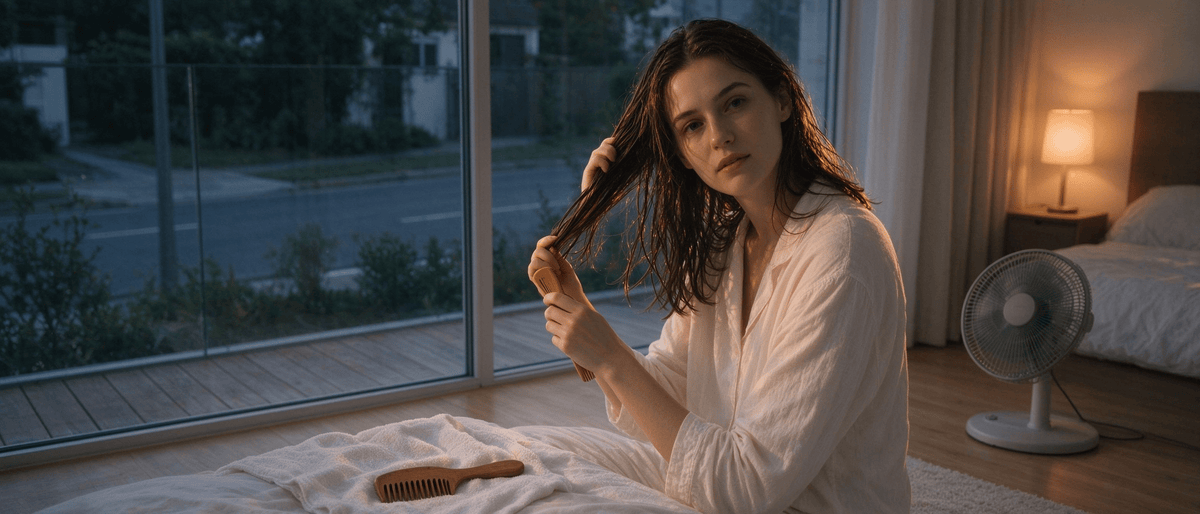
The short answer: extract the water with a towel first, then move air across the hair instead of heating it. Squeeze the water out in sections, wrap the hair in a microfiber towel for ten minutes, sit beside a fan or an open window, and comb from the ends upward once dripping stops. Wash early enough that the slow phase happens while you are awake and upright. Most shoulder-length hair reaches damp-dry in roughly an hour. Thick hair requires longer, and no towel alters that.
What is actually happening while hair dries
Wet hair retains water in two locations: a film on the surface of the strand and water bound inside the fiber. A towel reaches only the film. Everything afterward is evaporation, and evaporation depends on three variables — air velocity across the hair, air temperature, and how much moisture the surrounding air can still absorb. A still, steamy bathroom is the slowest location in the house for precisely this reason: the air around your head is already near saturation. A plain fan in a dry room outperforms an expensive towel, because it keeps replacing the humid boundary layer clinging to the hair.
Start with a towel, and stop rubbing
Rubbing hard against terry cloth is the step worth changing. Wet hair is at its most fragile, and friction against a rough towel is how ends turn rough in the first place. Press the towel against the hair and squeeze in sections from root to end, or fold the hair into a cotton T-shirt and press down with both palms. Then wrap it — microfiber if available, a clean cotton shirt otherwise — and leave it for ten minutes while you do something else. Ten minutes wrapped removes more water than ten minutes of friction, at no cost. A cotton T-shirt wicks marginally better than terry cloth, though the difference is smaller than most guides claim.
Keep the air moving
After the towel, the objective is air exchange rather than heat. Position a fan on the floor angled upward toward your head, open a window, or sit beneath a ceiling fan. In a humid room, a dehumidifier shortens drying time more than a heater does, because dry air accepts water vapor faster than warm, saturated air. Keep the hair loose so air passes through it instead of sitting in a dense mass against your neck. A hygrometer reading above sixty percent relative humidity indicates the room will not cooperate, however hard the fan runs. Parking in front of a radiator or space heater is not a shortcut: it warms the hair surface while the surrounding air remains still and humid, and it becomes a burn hazard if you fall asleep.
Comb in the right order
Breakage concentrates at the combing stage, so sequence matters more than the implement. Wait until dripping stops, then begin at the ends with a wide-tooth comb and work upward in small sections. Starting at the scalp and dragging downward pulls the tangle into the length. Hold the section above the knot so the tension lands on your hand rather than the root. A wide-tooth comb on damp hair is gentler than a brush on wet hair, and a brush on soaking hair is the combination to skip entirely.
Time the wash to your schedule
Timing outweighs technique as the dominant variable. Wash in the late afternoon or early evening, so the two hours of ambient drying happen while you are moving around the house rather than lying on a pillow. Damp hair against a pillowcase stays wet for hours, flattens the root, and abrades the cuticle through friction. If you wash late, give the hair at least half an hour in front of a fan before bed, and keep it loose rather than twisted into a wet bun.
How long it really takes
| Hair type and length | What helps most | Rough drying time |
|---|---|---|
| Fine, shoulder length | Airflow, light towel | About thirty minutes |
| Short, any texture | Towel, then air | Fifteen to twenty minutes |
| Thick, long | Towel wrap plus fan | Two hours or more |
| Curly, medium | Microfiber wrap, no combing | One to two hours |
These ranges assume a dry room with continuous airflow. Humidity adds time, a closed bathroom doubles it, and a dense head of hair retains water in the interior of the mass long after the exterior feels dry.
What it does to different hair types
Ambient drying is not neutral. Fine hair dries quickly but loses volume as it dries flat against the scalp, and it shows oil sooner because there is less hair to distribute sebum through. Thick and coarse hair holds far more water, so it remains damp in the middle while the surface feels dry, and the cuticle lifts unevenly and reads as frizz. Curly hair is the most variable: left undisturbed it may form definition, but handled while wet it separates into distinct clumps. None of this establishes a general advantage either way. It determines which hair types need assistance — airflow for thick hair, a light hand for fine hair.
What does not work
Several popular shortcuts merely prolong wet time. Sleeping with soaking wet hair keeps the scalp damp for eight hours; a towel turban left on all night accomplishes the same. Sitting in a hot room with closed windows traps the moisture you are losing. Wrapping hair tightly and leaving it there flattens the root and roughens the cuticle, and brushing wet hair aggressively produces the breakage you were attempting to avoid. Heat is not the sole mechanism: friction and prolonged wetness do the same work.
The research is more mixed than the internet suggests
A 2011 study in Annals of Dermatology compared hair dried in room air with hair dried using a hair dryer at three distances and temperatures — 15 cm at 47℃, 10 cm at 61℃ and 5 cm at 95℃ — across 30 treatments. Surface damage escalated with temperature, as anticipated. The surprise was that damage to the cell membrane complex appeared only in the group dried without a hair dryer, and that color changed measurably in the room-air group and the 95℃ group after ten treatments. Hair that remained wet longer was not automatically the safer hair. The practical reading is narrow: ambient drying is acceptable, but prolonged wetness carries its own cost.
When a device is the practical answer
Some mornings the honest answer is that ambient drying does not fit: a cold, humid day, thick hair, a meeting within the hour. That is a scheduling problem rather than a verdict on hair care. A compact high-speed dryer such as the SYLPH 2 portable high-speed hair dryer is rated 850W, moves air at 21 m/s and uses a stepless speed slider rather than fixed fan steps, which makes low-setting drying easier than hot-setting drying. If you are weighing a dryer against none at all, the wattage explainer covers what that 850W figure does and does not indicate, and the comparison of high-speed versus regular dryers explains why airflow matters more than heat. A device purchases time. It does not produce better hair than hair that dried in moving air.
Frequently asked questions
How long does it take to air dry hair?
For shoulder-length hair in a dry room with a fan, roughly an hour. Thick or long hair commonly needs two hours or more, and humidity can double either figure.
Can I air dry my hair overnight?
You can, but it is the slowest and least comfortable option. Hair stays damp against the scalp for hours, the root flattens, and the cuticle is abraded by friction against the pillow. Dry to damp before bed instead.
Does air drying damage hair?
Not by itself, but prolonged wetness is not free. Wet hair is weaker and more prone to stretching and breakage, and a study of repeated drying found measurable color change after room-air drying as well as after high heat.
How do you dry hair fast without a hair dryer?
Towel first, then air. Squeeze rather than rub, wrap for ten minutes, then sit in front of a fan in a dry room and comb from the ends up. Moving air contributes more than any other step, and a dehumidifier helps more than a heater on a humid day.