
Portable Hair Dryer Size: What Actually Fits a Bag
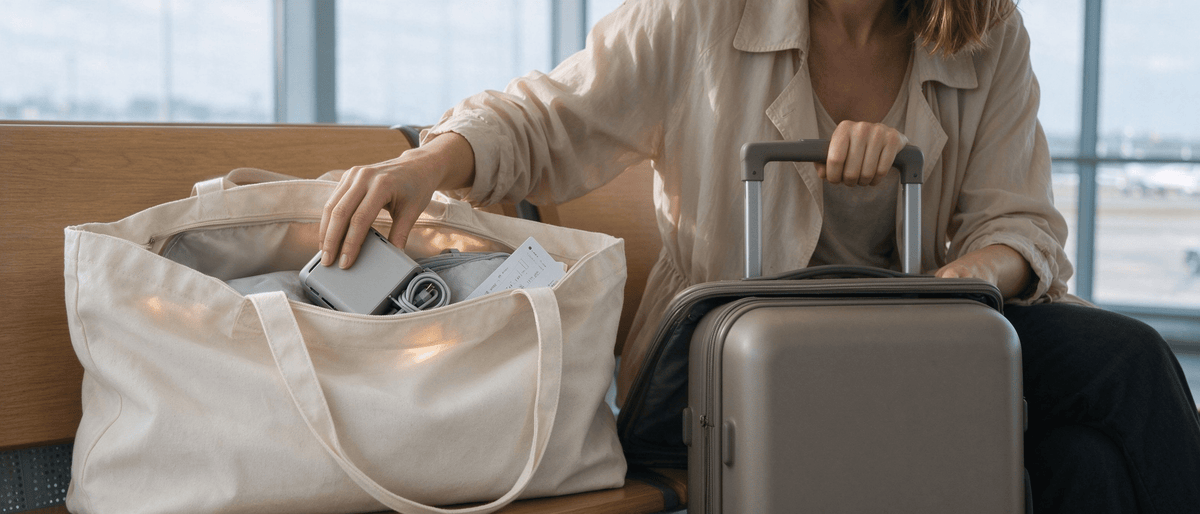
The short answer: judge a portable hair dryer by its packed footprint — body length, handle configuration, and carrying pouch — not by the word "compact" on the packaging. A 208 mm body with a fixed handle occupies more luggage space than the identical body with a folding mechanism, and a mini model can still be too long for a tote pocket. Measure the flat space your bag genuinely offers, then compare it against three measurements: the body length, the handle length once folded or fixed, and the dimensions of the carrying case that ships with the appliance. The specification sheet describes the dryer; the footprint determines whether it travels.
Why "compact" is a packing measurement, not a marketing word
Compactness is a direction rather than a guarantee. Manufacturers label a dryer compact when it is shorter or lighter than the preceding model, which says nothing about your intended pocket. An appliance can be compact in the hand yet awkward in a suitcase: the barrel is short but the handle protrudes, or the power cord refuses to coil.
Packing space is rectangular. The dryer either lies flat inside it or it does not. The genuinely useful question, therefore, is not "how small is this dryer?" but "how much of my luggage does this dryer occupy once packed?"
The three size variables that decide whether it fits
| Variable | What to measure | Why it changes the fit |
|---|---|---|
| Body length | Tip of the barrel to the base of the handle | Long bodies do not sink into shallow tote pockets and keep the bag open |
| Handle | Folded length versus fixed length | A fixed handle adds its full length to the footprint every time |
| Pouch | Whether a carrying case ships with the dryer | A padded case adds bulk and a zip, so the packed footprint is larger than the dryer |
The variables interact. A short body with a fixed handle can pack worse than a longer body with a folding handle, and a case-less dryer may still be bulkier once you add your own pouch. Compare candidates in the same configuration: body plus handle plus case, or none of the three.
Body length: what 208 mm actually buys you
A 208 mm body is approximately the length of a paperback novel and close to the height of a passport. That matters because most bag pockets are shallow. A tote's slip pocket, a backpack's laptop sleeve, and the front pocket of a carry-on suitcase are sized for flat objects, not for an L-shaped appliance.
Close to the pocket depth, the dryer sits inside with the handle protruding; longer, it lies diagonally and steals space from everything adjacent. Measure the pocket before you fall in love with a specification.
The handle question: fixed or foldable
Buyers most often overlook this variable, which changes packing most. A fixed handle is part of the footprint at all times. A folding handle disappears into the body, so the dryer becomes a rectangle that lies flat.
Folding handles carry a trade-off: the hinge adds a moving part, and some fold only one way, so cord routing detours around them. For a bag with a flat pocket, a fold usually outweighs a shorter barrel; for a home drawer, the difference rarely matters.
The pouch is part of the size
A leather or fabric case is not free space. It adds padding and often requires zip clearance. If two dryers measure identically and one ships with a case, the cased one is bigger when packed — unless you leave the case at home.
The pouch also decides placement: a cased dryer shares a bag with clothes without snagging them, while a bare dryer needs an empty pocket, not just a large one.
How to measure the space in your own bag
Find the space you would actually use, then measure it rather than the bag's exterior. Cabin limits are tighter than they look: American Airlines caps a carry-on at 22 x 14 x 9 inches including handles and wheels (American Airlines carry-on rules), and United lists 23 cm x 35 cm x 56 cm (United carry-on bags). A dryer that fits a tote pocket fits either limit.
| Bag | Where the dryer would go | What to measure |
|---|---|---|
| Tote | Slip pocket or the gap beside a laptop sleeve | Pocket depth and width |
| Carry-on suitcase | Packing cube or the flat lid compartment | The cube's internal length |
| Gym bag | Side pocket or the space above shoes | Side pocket depth |
| RV cupboard | A drawer or shelf corner | Drawer height, not width |
Write the three measurements down, and compare dryers against those numbers rather than each other.
Cord and plug bulk
Cord length is invisible in a specification sheet and obvious in a packed bag. A long cord requires coiling space, and a stiff cord coils poorly. The plug adds a rigid lump that presses into adjacent items. Before deciding a dryer fits, wrap its cord the way you would on the road and see whether the bundle still fits the pocket.
A region-specific version also fixes the plug shape to its country of sale, so you carry the correct plug instead of an adapter block. Choose the version matching your destination country, and the plug stops being extra bulk.
What size does not tell you
Size says nothing about drying performance. A shorter body can still move a lot of air, and a longer one can be weak. Examine motor speed, airflow, and heat settings separately: a 110,000 rpm brushless motor moves air at 21 m/s, roughly 5x faster drying than a conventional dryer, and the four heat modes (intelligent, 78°C, 58°C, and room temperature) decide how the hair feels afterward.
That is the balance to aim for: a body small enough for your pocket, with airflow high enough that you are not holding it there twice as long. Size is a packing question; airflow is a hair question. Do not let one answer the other.
A checklist before you buy
- Measure the pocket you plan to use, in every direction.
- Note the dryer's body length, not the length of its packaging box.
- Check whether the handle folds, and if it does, how far.
- Decide whether the case ships with the dryer and whether you will carry it.
- Picture the cord wrapped and check whether the bundle fits.
- Compare airflow and heat settings only after the dryer has passed the first five steps.
A dryer that fails step one fails the rest, however good the airflow appears. Size is the cheapest thing to check and the most expensive attribute to get wrong.
Frequently asked questions
Can I find a mini hair dryer that dries hair quickly?
Yes, if you judge by airflow rather than physical dimensions. A compact body with a 110,000 rpm brushless motor moves air at 21 m/s, which is roughly 5x faster drying than a conventional dryer. Drying time comes from the air, not from the length of the barrel.
Are mini hair dryers as powerful as full-size ones?
Not automatically, and not because of dimensions. Power in a hair dryer is airflow multiplied by heat, so a small dryer with a high-speed motor can outperform a larger one with a weak fan. Compare motor speed, airflow, and wattage.
Is a mini hair dryer good for thick hair?
It can be, provided airflow is high and heat is adjustable. Thick hair needs air volume more than a large body, and the four heat modes let you dry at 78°C, drop to 58°C, or finish on room temperature. Hold the dryer where the air reaches the roots, not just the surface.
Do I need a plug adapter for a portable hair dryer?
That depends on the version you buy. SYLPH 2 ships in region-specific versions for China, the United States, Europe, the United Kingdom, and Japan. Choose the version matching your destination country, because the voltage is fixed per model and a plug adapter does not change it.
For a closer look at the measurements used here, see the SYLPH 2 specification page. If your question is about the shape of the dryer rather than its size, the stick hair dryer guide covers that trade-off, and the travel hair dryer guide goes through the rest of the packing list.