
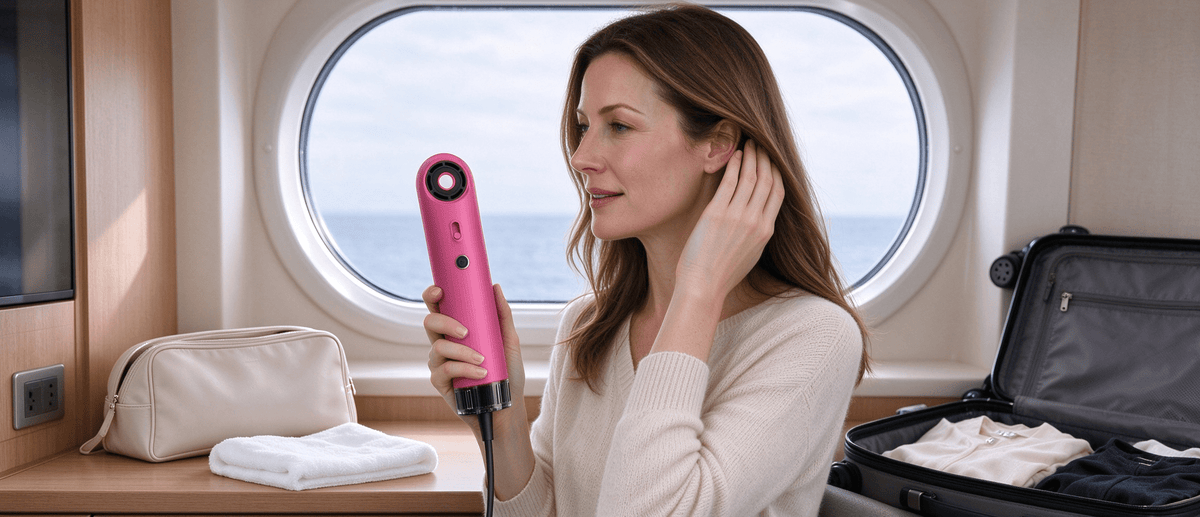
Can You Bring a Hair Dryer on a Plane or a Cruise? What the Rules Say
Two rulebooks apply to the same object. At an airport, a hair dryer is a non-issue. On a cruise ship it can be taken off you — not because hair dryers are banned, but because of how much power one draws. Knowing which rulebook applies is most of the work.
At the airport: carry-on and checked are both allowed
US airport security lists hair dryers as permitted in carry-on bags and in checked bags, with no special instructions attached: no wattage limit, no quantity limit, nothing to declare. Corded curling irons and flat irons are treated the same way.
It does not have to come out of your bag at the checkpoint either. Officers ask for laptops, tablets and e-readers in a separate bin; hair dryers are named as an exception, alongside electric shavers and toothbrushes.
Nothing airline-specific needs researching: screening at US airports is federal, not carrier-run, so the same dryer passes any checkpoint. What varies is baggage allowance.
Why it never appears on a restricted list
Security screens for weapons, explosives and fire risks. A corded hair dryer is none of the three: it cannot run without a wall outlet.
Battery-powered tools are the exception. A cordless dryer with a lithium cell follows battery rules: device and spare cells in the cabin, never the hold. If your dryer has a cord, none of that applies.
Carry-on or checked: how to decide
Since both are permitted, the choice is practical: carry-on if you would rather not risk a delayed bag, checked if you are traveling with a full-size model and have room to cushion it.
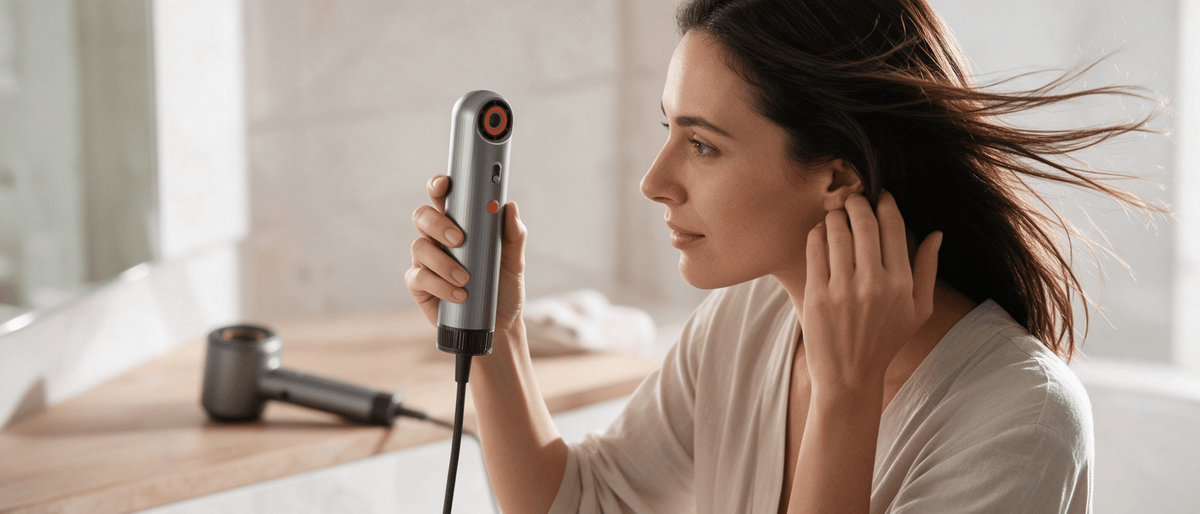
The failure mode is mechanical, not regulatory: a dryer loose in a suitcase gets its casing cracked or its cord strained where it enters the handle. Size is what makes carry-on the easy answer — SYLPH 2 weighs 248 g, measures 45 × 45 × 208 mm, and packs into the leather pouch supplied with it. If the dryer has to earn its place in a carry-on, our guide to choosing a compact travel dryer sets out what to compare.
On a cruise ship, a different rule applies
Ships prohibit appliances that generate heat: irons, steamers, kettles, hot plates, heating blankets — because of the ship's electrical system and fire risk in a confined space.
Hair dryers sit in an explicit exemption on the major North American lines: treated as personal grooming devices, permitted in the stateroom, with the line keeping the right to remove anything a security officer judges hazardous. Every major line also provides one, which is why packing your own is optional rather than necessary.
What the major lines publish
- Carnival: personal grooming devices including hair dryers are permitted “when used with proper caution”; anything judged hazardous is removed and returned at the end of the cruise.
- Royal Caribbean: hair dryers, curling irons and straighteners are permitted, and each stateroom has a dryer.
- Norwegian: hair dryers and flat irons are allowed, and the line notes a converter may be required.
- Disney Cruise Line: permitted, with a ceiling of 1,500 watts on the ship's North American outlet and 2,000 watts on the European one (2,000 watts on Disney Adventure).
These summaries come from each line's published policy pages as of October 2026; policies change, so confirm before you sail.
The number that decides it: wattage per outlet
Only one of these lines publishes a wattage ceiling, but the ceiling describes the problem: a ship cares how much current one outlet must deliver.
Read the label, take the maximum wattage, compare it with your line's limit. SYLPH 2 is rated at 850 W maximum, well under the 1,500-watt ceiling Disney publishes for its North American outlet. The maximum is the figure that matters, not an average across settings.
A dryer over the limit is confiscated as an item, held at the terminal and returned at disembarkation.
Voltage on board is not the same as voltage ashore
A ship generates its own power, and cabins are commonly fitted with two outlet types — North American and European, at different voltages. Royal Caribbean states that onboard voltage covers both, and advises guests to bring both adapters.
The consequence is direct: the outlet you plug into decides which version is correct. A dryer built for the North American outlet is right when that is the outlet at the vanity; a cabin with only the European outlet needs the version built for it.
SYLPH dryers are built in versions matched to destination markets, so the version is settled at purchase, not by an adapter. Our guide to travel hair dryer voltage covers this in full; the short rule is to match the version to where you will actually use it.
A five-minute check before you pack
- Read the maximum wattage from the label and note it down.
- Open your line's prohibited-items page and find the grooming-device section.
- Confirm which outlet type your stateroom has, and whether it matches the dryer version you own.
- Decide carry-on or checked on space and protection — not on permission.
- Coil the cord loosely with slack at the base, so the plug does not pull on the connection.
Air travel and cruising look like one question and are two. At the airport the answer is a flat yes in either bag. On a ship it is also yes — but with a number attached, and that number is printed on your dryer. Full specification is on the product page.

Written by SYLPH



Leave a comment
This site is protected by hCaptcha and the hCaptcha Privacy Policy and Terms of Service apply.