
How to Dry Bleached and Colored Hair Without Adding Damage
Bleached hair is not simply lighter hair. It is hair that has been chemically opened, had its pigment oxidized away, and left with fewer internal bonds than it started with. None of that reverses at home. What you control is what happens next: repeated heat over the same sections, on hair that is already weaker.
The useful question is not which dryer is gentle in the abstract, but how much heat your hair gets, and for how long.
What bleaching does to a strand
Bleach — whether the goal is blonde, highlights or a vivid shade — oxidizes the pigment inside the cortex. To reach it, the cuticle — the overlapping outer layer — has to lift, and some of that lift never fully reverses. That is why bleached hair feels rougher and loses water faster than it did before.
Two consequences follow. Water escapes faster, so hair swings from wet to dry and then loses moisture if you keep drying. And tensile strength drops, which is why bleached hair snaps when combed wet.
Deposit-only color is milder: a direct dye or toner sits at the cuticle rather than breaking bonds deeper in the cortex. The routine around it still accumulates the same way.
Heat exposure is a total, not a setting
Most advice about drying damaged hair is about the temperature dial. It matters, but it is half the calculation; the other half is time.
Time runs long because hair is still dripping, sections are too thick, airflow is weak, and you go over the same area again.
Two ways to cut that without more heat. The first is mechanical: get water out before the dryer goes on, because five minutes in a towel removes much of what would otherwise have to be evaporated. The second is airflow: moving air carries the humid layer away, so evaporation continues at a lower temperature.
This is why fixed output suits porous hair badly. A dryer pushing the same heat into a soaking section and a nearly dry one over-delivers for most of the session.
What to look for in a dryer for bleached or colored hair
- **A genuine low-heat setting, not just a low fan speed.** Many dryers slow the fan and keep the element hot.
- **Regulated temperature.** A dryer that monitors and adjusts its own output holds steady; a fixed high setting keeps pushing.
- **Stepless airflow.** Slowing the air without losing control matters most at the hairline.
- **Negative ion output, if static is your problem.** Ions neutralize the charge that makes porous hair cling — a surface effect, not a treatment.
- **Low weight.** A tired arm holds the dryer closer and in one place, and that is how a careful routine becomes a hot spot.
How to dry bleached or colored hair, step by step
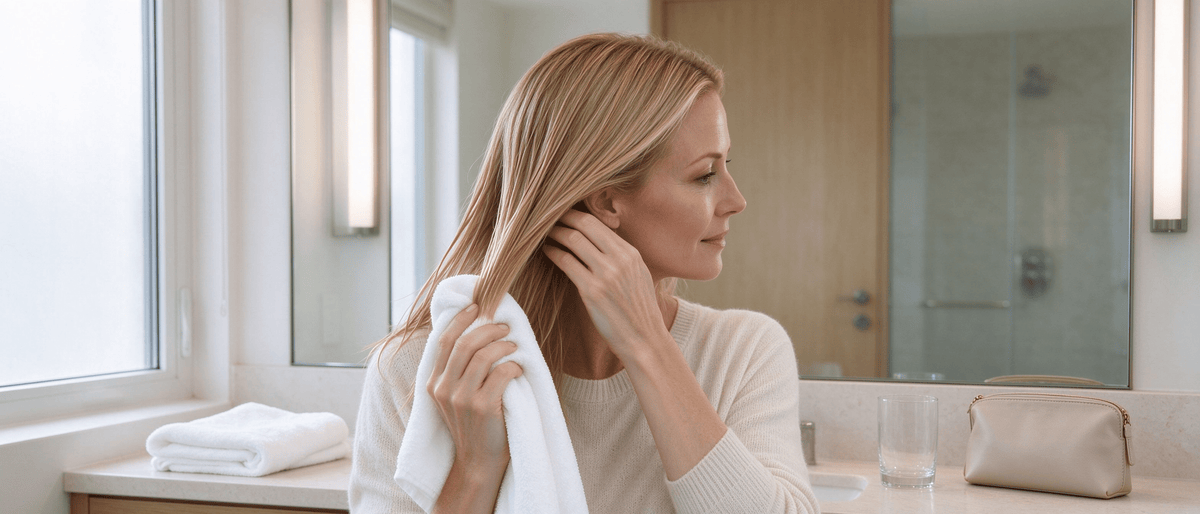
- Towel-dry for five to ten minutes. Press, do not rub — rubbing roughs up a lifted cuticle.
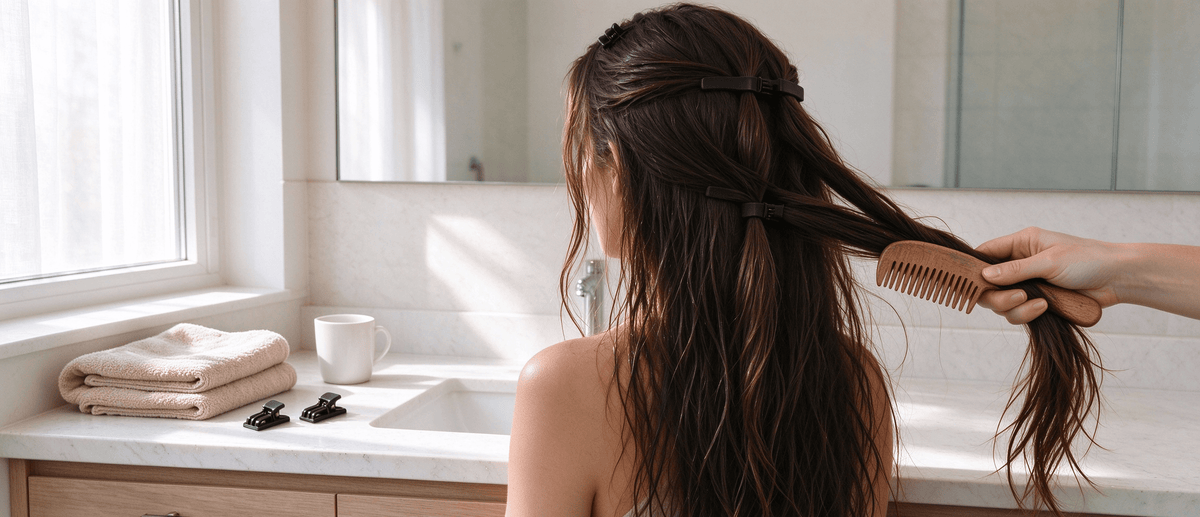
- Detangle while damp with a wide-tooth comb, ends first.
- Set the lowest heat that still feels warm on your scalp. Too cool and you will hold the dryer closer.
- Start at the roots, keeping the outlet a hand's width from the hair.
- Keep moving. Two slow passes are gentler than one pass held still.
- Finish on cool or room temperature, and stop while the ends still feel slightly heavy.
Habits that undo a good routine
- **Drying soaking wet hair on the highest setting.** The longest exposure of your week.
- **Holding the dryer still.** Heat builds with nothing moving it away.
- **Brushing wet bleached hair under tension while the air is hot.** Weak fiber, tension and heat at once.
- **Going back over hair that is already dry.** Nothing is drying; it is pure exposure.
What a hair dryer cannot do
A dryer cannot rebuild a bond that bleach broke, put protein back that has washed out, or keep dye from fading. Those are chemistry questions, not airflow questions.
If your hair stretches when wet, feels gummy or breaks in short pieces, a different dryer is not the answer — that is a conversation with whoever colors your hair. Drying well is the part you control between appointments, not a substitute for it.
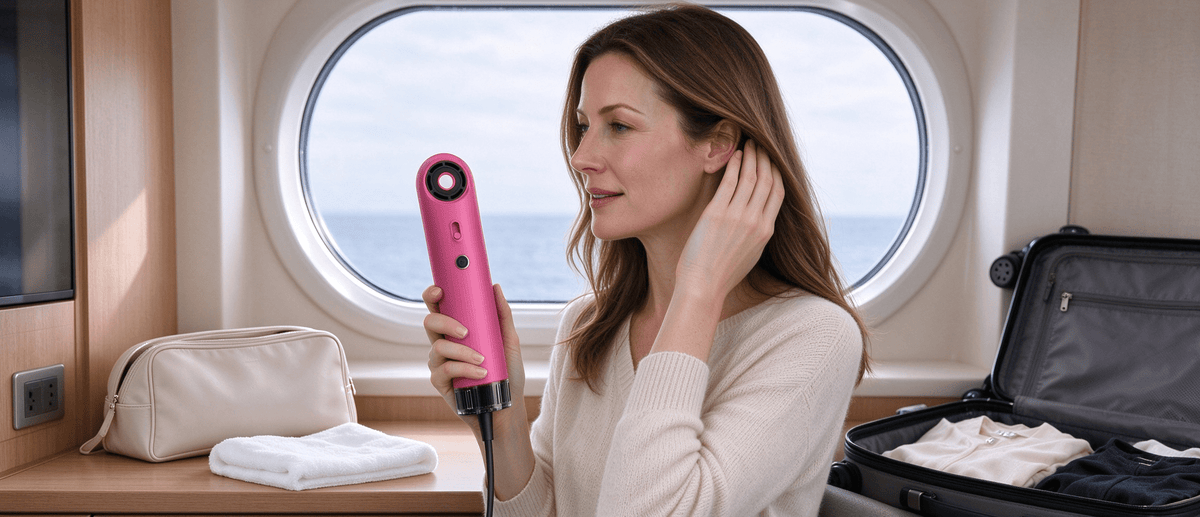
How SYLPH 2 is set up for this
Three things on SYLPH 2 matter here:
- **Temperature readings 100 times per second at the outlet.** Output adjusts continuously, so air temperature stays where you set it instead of drifting up as hair dries.
- **Four temperature modes**: a smart mode that varies output as hair dries, a styling mode at 78°C, a gentle 58°C, and room temperature. Gentle is usually enough for porous hair; room temperature is for the final pass.
- **A stepless airflow slider.** You set airflow continuously rather than picking two or three fan steps, so you can slow the air at the hairline without losing power over the roots.
Negative ion output is rated at 200 million, which addresses static and flyaway. At 248g and 45 × 45 × 208 mm, the body is small enough to hold at an angle while you reach the back of your head.
The full specification is on the SYLPH 2 product page.
The short version
Bleached and colored hair needs less heat and less time, not a stronger dryer. Towel the water out first, set the temperature lower than feels necessary, keep the air moving, and stop before the ends are bone dry.
*Related reading: what separates a high-speed dryer from a regular one, and drying fine or thinning hair for volume.*

Written by SYLPH


Leave a comment
This site is protected by hCaptcha and the hCaptcha Privacy Policy and Terms of Service apply.